
A result presented at a 2005 conference might be checked against an established dataset, challenged at a poster session, and adapted by another lab before a longer journal article appeared. That pace made conferences important to AI research in the 2000s. They shaped which problems drew attention, what counted as evidence, and how techniques moved among speech, vision, language processing, and machine learning.
These conferences served different communities. NeurIPS, then called NIPS, and ICML brought together researchers developing learning algorithms. CVPR and ICCV were central to computer vision; ACL and related meetings served computational linguistics; INTERSPEECH and ICASSP carried major speech research. Some venues focused on methods, others on applications. Across them, a lab could put a bounded claim before reviewers and attendees, then publish enough of the work for others to test or extend it.
A faster research cycle, with limits
Conference deadlines pushed teams to finish experiments, define evaluations, and say what differed from earlier work. Proceedings made those accounts available to cite or reproduce. In fast-moving areas such as statistical machine learning, researchers could respond to a result without waiting for a journal article.
The format shaped the claims, too. Page limits favored a clear contribution: an algorithm, a feature representation, an evaluation protocol, or a gain on a recognized task. Questions after a talk could expose a weak baseline or a questionable dataset assumption. At a poster, someone might ask whether a result held under different training conditions. Those exchanges seldom made it into the proceedings, but they could determine the next experiment.
Speed was not verification. Reviewers had limited time, paper quality varied, and short submissions could omit implementation details. A reported gain might hinge on a data split or tuning choice. Conferences circulated claims quickly; independent testing still mattered.
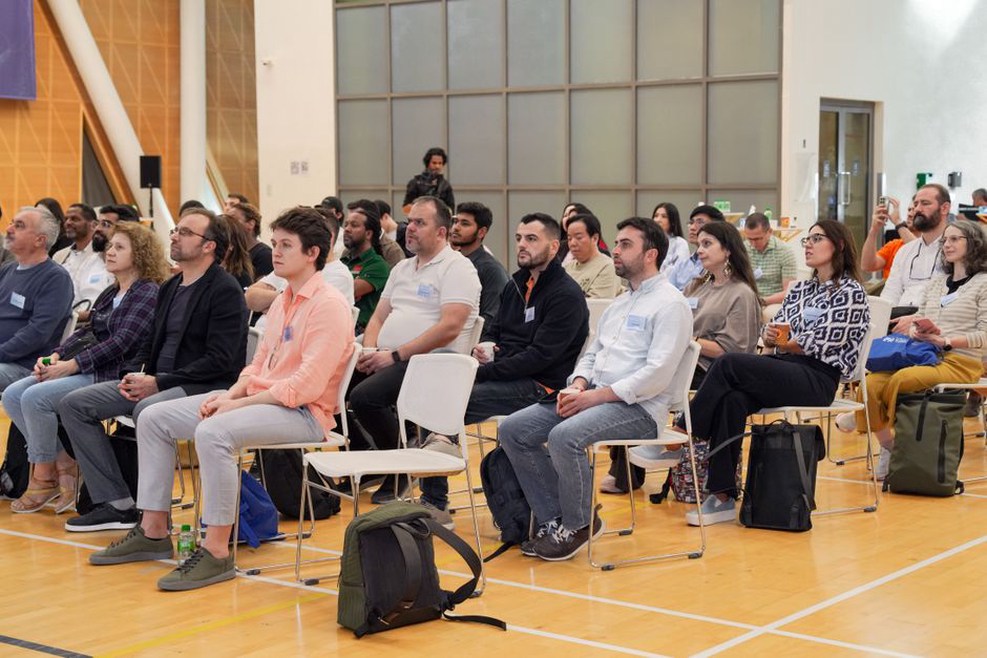
Shared tasks made progress easier to inspect
Comparisons became more useful when researchers worked on the same task. Speech recognition, document analysis, face recognition, and image classification drew on datasets, evaluation campaigns, and published scoring rules. Conferences did not create all of these resources; research agencies, universities, professional societies, and workshops also organized them. But meetings gave participants a place to present results, challenge metrics, and find out what competing systems had actually done.
The point was not just a leaderboard rank. A shared test might show that a speech method worked on clean recordings but struggled with background noise, or that a vision system faltered when the camera viewpoint changed. Stated training and test data, error measures, and comparison systems let readers assess a claim more carefully than a demonstration could.
Benchmark scores were also easy to overread. Any dataset represents a selected part of the world. Repeated experiments on familiar tests could favor methods suited to those tests, even without access to held-out labels. Large teams could more readily afford the computing and annotation work. A strong conference result answered a specific question about performance under stated conditions, not whether a system was ready for every possible use.
What a comparison needed to disclose
- Task definition: Did success mean identifying a spoken language, finding an object, or measuring a structure in a medical scan?
- Data boundaries: Which recordings, documents, or images were used for training, development, and final testing?
- Metric: What counted as an error, and did one score hide important failures?
- Baseline: Did the system improve on a credible existing approach under comparable conditions?
- Practical constraints: What annotation, runtime, or computing resources did the result require?
That vocabulary helped researchers read beyond their specialties. A machine-learning researcher could understand why held-out data and baselines mattered in a speech paper without knowing every detail of acoustic modeling. Shared evaluation habits made exchanges across conferences more productive.
Methods crossed disciplinary boundaries
Much of the decade’s AI research involved adapting methods to new problems. Support vector machines, graphical models, feature selection, and structured prediction appeared across application areas. A technique presented at a machine-learning meeting might next be tested on document classification, object recognition, or a speech-related decision. Specialists could then show where it worked and where their data called for changes.
No single algorithm solved all of those problems. Speech unfolds over time; printed pages have layout as well as words; images contain spatial relationships and changes in scale. Conferences put general methods in contact with such domain-specific objections. Application papers, in turn, could pose problems that prompted new methodological work.
The late-2000s interest in deep learning is a useful reminder not to read later outcomes into earlier papers. Neural-network research continued throughout the decade, including at major machine-learning meetings, but it did not immediately replace established systems across applications. ImageNet, published in 2009 in work associated with CVPR, provided a large-scale image-recognition resource. Its later part in deep-learning breakthroughs does not mean those breakthroughs were standard practice in 2009. Conference papers show the available ingredients and open questions at the time.
Workshops and neighboring sessions mattered
Important exchanges happened outside main-track talks. Workshops could give a specialized task, preliminary result, or difficult dataset more room than a larger venue allowed. A researcher working with little transcribed speech for a language faced a different evaluation problem from a team with extensive labeled recordings. A smaller meeting could examine that constraint rather than relegating it to a footnote.
Neighboring sessions offered other connections. A document-analysis researcher studying page layout might hear how computer-vision researchers represented spatial structure. Someone working on medical-image segmentation might take useful ideas from discussions of validation, while still having to address clinical and imaging-specific questions that a general benchmark could not settle. Such encounters did not guarantee collaboration, but they brought work to people who might not read the same journals.
Even familiar technical terms needed translation. “Recognition,” “tracking,” and “classification” could describe very different experiments. Explaining a task to another specialty forced authors to spell out its inputs, labels, outputs, and failure cases. That made reuse more plausible without treating unlike problems as identical.

Who could participate shaped what grew
Conference-driven research depended on access. Travel budgets, visas, registration fees, computing resources, and time to prepare a submission all affected who could take part. Proceedings reached readers beyond the meeting room, but a workshop conversation or an introduction in person was not equally available to everyone. Labs with established networks could hear about emerging tasks and potential collaborators earlier than more isolated researchers.
Data access mattered as much as attendance. In speech and language research, large shared collections made well-resourced languages easier to evaluate. A method designed for a low-resource language could be hard to compare with one trained on extensive transcriptions. Medical-image studies faced data-sharing restrictions and differences between scanners. In biometrics, a score on one collection might obscure changes in capture conditions or in the population being tested. These constraints determined what a conference result could reasonably establish.
Peer review filtered the record as well. It could press authors to support claims and credit earlier work, while favoring familiar tasks and improvements that were easy to score. Negative results and careful dataset construction often fit the compact novelty story less comfortably, even when they mattered. Proceedings therefore record both research advances and the kinds of work conference formats encouraged authors to report.
Reading a 2000s conference paper in context
A venue is a clue, not a quality certificate. Start with the problem the authors saw as unsolved, then separate their contribution from the test used to support it. Did they propose a learning procedure, a representation, a dataset, or a better way to combine existing components? A system might matter because it made evaluation repeatable, even if later systems beat its headline accuracy.
Then examine the scope of the comparison. A gain over one baseline says less than a gain tested under several conditions. A laboratory dataset can show promise without showing that a method works in a hospital, on a crowded street, or with speakers unlike those in its training data. Later citations can trace influence, but counts alone cannot distinguish adoption from criticism or routine background references.
Missing details are evidence, too. If a paper gives no runtime, uncertainty estimate, or clear account of annotation, a modern reader should not fill in the blanks. Compare the conference version with later work by independent groups: did they use the same metric, find the same failure modes, and still consider the original claim useful?
For a concrete exercise, take a 2007 object-recognition paper that reports a higher score than an earlier system. Before reading its algorithm, note the dataset, training/test division, metric, and baseline. Those four details tell you what improved—and what the conference audience was being asked to believe.