
In the mid-2000s, the contact image sensor (CIS) quietly replaced the charge-coupled device (CCD) as the dominant imaging technology in flatbed scanners, fax machines, and even early fingerprint readers. Unlike the lens-based CCD systems that required precise optical paths, CIS placed a linear array of red, green, and blue LEDs directly against the glass platen, with a corresponding photodetector strip just a few millimeters away. This design eliminated the need for mirrors and lenses, making scanners significantly cheaper to produce—the CIS module cost a fraction of a CCD assembly—and also thinner and more energy-efficient. But the contact requirement also introduced new constraints for pattern recognition researchers working on document processing and biometrics.
The Rise of Contact Image Sensors
Canon introduced the first CIS-based scanner, the CanoScan LiDE 20, in 2003. By 2005, CIS had captured over 60% of the consumer scanner market. The sensor worked by illuminating the document through a transparent platen and capturing reflected light with a photodetector array that was effectively in contact with the glass. Because the depth of field was only about 0.5 mm, the document had to be pressed flat against the glass — any curl or crease would cause blurring. For document processing algorithms, this meant that skew detection and dewarping had to handle slight out-of-focus artifacts, especially near the spine of bound books. Researchers at the International Conference on Document Analysis and Recognition (ICDAR) in 2005 presented methods to correct CIS-related distortions using polynomial models of the platen surface.
From CCD to CIS: A Hardware Shift
The CCD scanner of the 1990s relied on a lens to project the entire page onto a sensor, offering a depth of field of several centimeters. CIS traded that depth for a thinner profile. For pattern recognition, the practical consequence was that OCR engines had to be retrained on CIS-captured images, which exhibited different noise patterns — especially a periodic banding caused by slight misalignment of the LED rows. The mid-2000s saw the publication of several papers on adaptive thresholding and banding removal specific to CIS scanners, notably by the group at the University of Maryland’s Language and Media Processing Laboratory.
CIS in Document Processing: Algorithms and Challenges
Document processing pipelines that assumed CCD-like sharpness failed on CIS scans. Skew detection algorithms based on Hough transforms, for example, often mistook the faint horizontal banding as text lines. The solution, published at the 2006 Workshop on Document Image Analysis, was to pre-filter the scan using a notch filter tuned to the known LED switching frequency. Another issue was the uneven illumination across the scan width: CIS units often had slightly weaker LEDs at the edges, requiring a flat-field correction step that many early commercial SDKs omitted. Researchers building multilingual OCR systems for low-resource languages — such as the scripts used in Ethiopian or Tibetan documents — found that CIS artifacts disproportionately affected thin strokes, leading to segmentation errors. This drove the development of stroke-width normalization techniques that later proved useful for historical document analysis.
- Flat-field correction: A calibration scan of a white reference strip was used to compute per-pixel gain factors.
- Banding removal: Fourier-domain filtering to suppress periodic noise from LED multiplexing.
- Dewarping: Thin-plate spline models to correct curvature from book spines.
Contact-Based Biometrics: Fingerprint Scanners
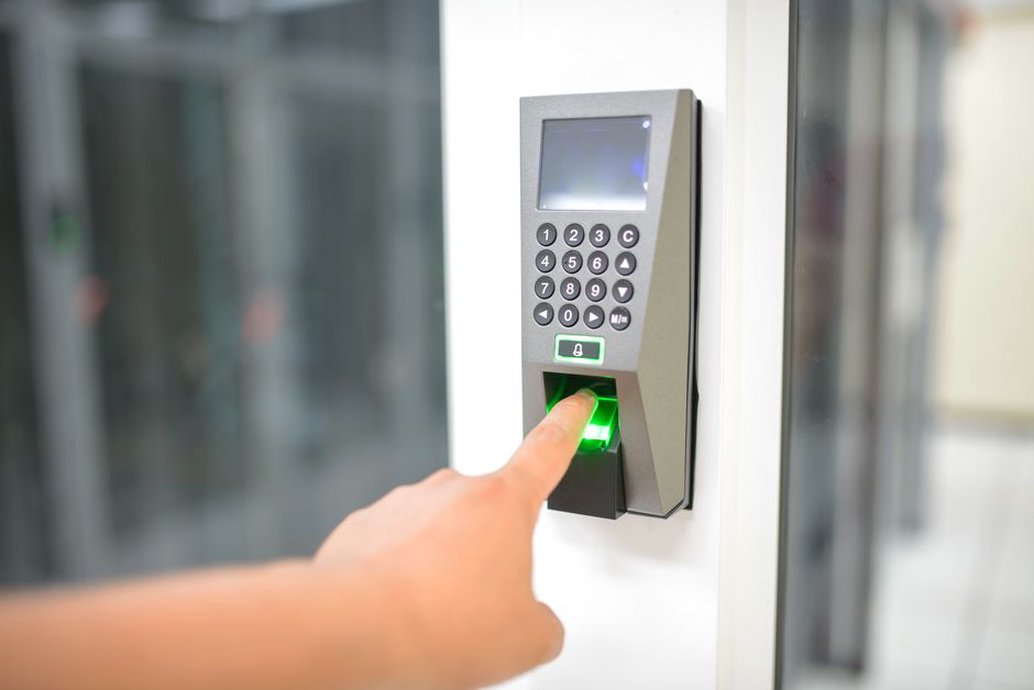
The same CIS technology found a second life in optical fingerprint readers. In 2004, DigitalPersona released the U.are.U 4000, a USB fingerprint scanner that used a CIS-like linear sensor. The user slid their finger across a narrow slit, and the sensor captured a sequence of line images that were stitched into a full fingerprint. This contact-based capture method was cheap—the sensor cost under $10—and compact enough to fit in a USB dongle, but it suffered from latent prints — residue from the previous user could create false minutiae. Researchers at the 2007 Biometrics Symposium proposed a method to detect latent contamination by analyzing the temporal consistency of ridge flow across successive scans. The contact requirement also raised hygiene concerns in public kiosks, prompting work on contactless fingerprint capture using structured light and stereo reconstruction. By 2008, the U.S. National Institute of Standards and Technology (NIST) had published a benchmark comparing contact-based and contactless fingerprint images, showing that contactless systems still lagged in accuracy but offered advantages in speed and user acceptance.
Contact Microphones for Speech in the Mid-2000s
Outside the visual domain, the concept of contact-based sensing also influenced speech recognition. Contact microphones — piezoelectric sensors that pick up vibrations directly from the skin or throat — were studied as a way to capture speech in high-noise environments like factory floors or military cockpits. The mid-2000s saw several projects funded by DARPA’s Robust Automatic Speech Recognition program, which combined a conventional air microphone with a throat contact microphone. The contact channel provided clean voicing information even when the acoustic channel was saturated. However, the frequency response of contact microphones was limited to about 4 kHz, making it unsuitable for fricative consonants. Researchers at the 2006 Interspeech conference demonstrated a fusion approach that used the contact signal to estimate the fundamental frequency and then enhanced the acoustic signal via harmonic reconstruction. This technique later influenced the design of bone-conduction headsets for mobile phones.
Legacy and Lessons
The shift to contact sensors in the mid-2000s had lasting effects. The banding correction techniques developed for CIS scanners later found their way into image processing pipelines for early smartphone cameras, which faced similar shallow depth-of-field issues. In biometrics, the push for contactless capture led to structured-light fingerprint scanners that eventually appeared in devices like the iPhone 5S. And the contact microphone research directly influenced the design of bone-conduction headsets used in modern mobile phones. By 2008, CIS had become the standard in consumer all-in-one printers, while research into contactless fingerprint capture using structured light was already underway—a technology that would later dominate mobile biometrics.