
An iris camera and a face camera could observe the same traveler and come away with very different evidence. The iris system needed a sharp, well-positioned image of the fine texture around the pupil. A face system could use a more ordinary photograph, but lighting, pose or expression might change the result substantially. In the mid-2000s, choosing a biometric system was less about finding the single best trait than about deciding which measurements a particular setting could capture reliably.
Fingerprints remained prominent, while researchers and operators also examined faces, irises, hands, voices and gait. Each method turned a human characteristic into a stored representation, or template, for later comparison. That process was not simply recognition by sight or sound in digital form. Capture conditions, quality checks, matching algorithms and decision thresholds all affected the result.
What the system was being asked to decide
A biometric application could perform verification, comparing a new sample with the template for a claimed identity, or identification, searching a gallery for possible matches. Verification is generally a one-to-one comparison; identification may involve many candidates. In a large gallery especially, the top-ranked search result was not proof of identity.
That is why mid-2000s evaluations tracked more than a single accuracy figure. A false match accepted samples from different people as belonging to one person; a false non-match rejected samples from the same person. Changing the acceptance threshold altered the balance between the two. Researchers also had to count failure to acquire, when no usable sample could be captured, and failure to enroll, when enrollment yielded no suitable reference. If a report counted only successful captures, a difficult field system could look deceptively strong.
Face recognition: convenient capture, difficult variation
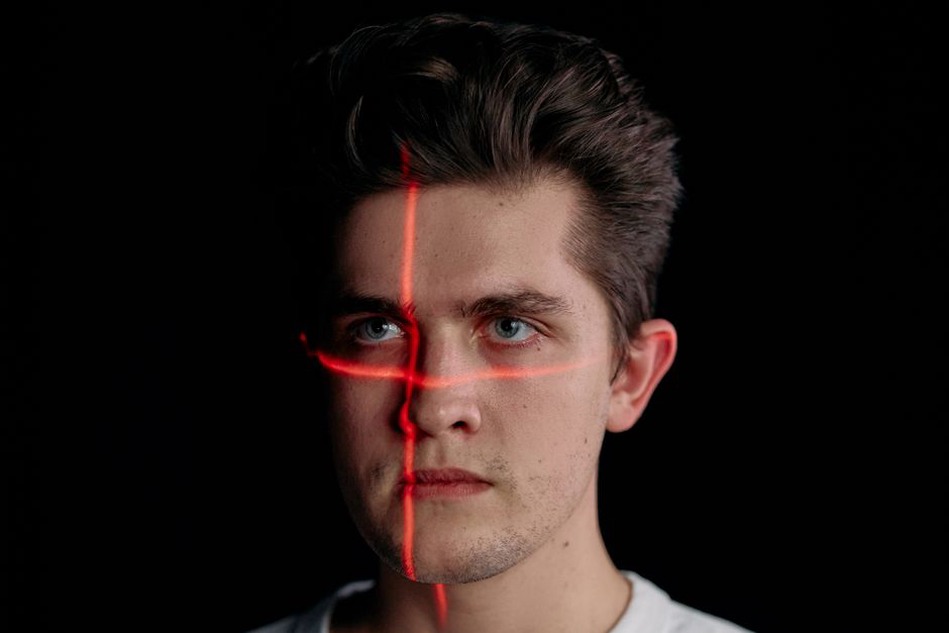
Faces appealed in part because cameras were familiar and did not require a dedicated contact sensor. But a controlled enrollment portrait was nothing like a face picked out of a crowded frame. Researchers first had to find and align the face, then contend with head angle, illumination, expression, resolution and the time elapsed between photographs.
Methods of the period included geometric measurements and statistical representations of facial appearance, often preceded by processing to reduce lighting and alignment differences. The capture setting mattered just as much as the choice of method. A checkpoint with consistent lighting and a person facing the camera posed a different problem from a search through incidental video. The United States National Institute of Standards and Technology documented contemporary testing in its Face Recognition Vendor Test 2006 overview, which illustrates the importance of measuring performance under specified conditions.
Iris and hand measurements required different compromises
Iris: detailed texture, demanding acquisition
The iris offered detailed visible texture that could be encoded and compared efficiently once the system had a suitable image. Getting that image was the harder part. The eye needed adequate resolution and focus, with little obstruction from eyelids or eyelashes. Changes in pupil size could alter the iris’s apparent geometry, making segmentation and normalization important before matching.
Iris recognition therefore depended heavily on the capture station. Even a strong matcher could not repair an image whose iris boundary had been badly located. Early deployments commonly used guided positioning and specialized illumination rather than relying on arbitrary photographs. The broader iris-recognition overview describes how image capture, iris localization and template comparison fit together.
Hand geometry and veins: useful distinctions
Hand-geometry readers measured finger lengths, widths and overall hand shape. Their appeal lay partly in relatively straightforward capture and comparison, not in a claim that every measurement was exceptionally distinctive. They made the most sense for verification within a managed population, such as an access-control roster, rather than identification across a very large gallery.
Vein-imaging systems sought a different signal: patterns beneath the skin, typically captured with near-infrared imaging. Although often grouped with hand biometrics, vein imaging was not hand geometry. The hardware, image-quality concerns and evidence differed. For either method, an advantage measured at one installation might depend on how consistently people presented their hands to the reader.
Voice and gait crossed into ordinary signal processing
Voice biometrics converted recordings into features for comparison with a speaker model. Speech recognition tries to recover words; speaker recognition asks whether a recording is consistent with a particular speaker. The tasks could draw on related acoustic tools, but a correct transcript did not establish who spoke, and a speaker match did not establish what was said. Our discussion of speaker diarization and the “who spoke when?” problem covers a third task: separating speakers across a recording without necessarily verifying their identities.
Telephone lines made voice sampling practical at a distance, though channel differences, background noise, illness and speaking style could shift the measured features. A system using a fixed passphrase could compare closely similar speech at enrollment and testing. Text-independent recognition had to cope with changing words. Either way, a short or noisy recording offered less evidence, even when the matcher produced a numerical score.
Gait recognition looked for patterns in how someone walked, often using video silhouettes or sequences of body movement. It held out the possibility of recognition at distances where a face lacked useful detail. Yet viewpoint, walking surface, carried objects, footwear, clothing and speed could all change a person’s apparent gait. Results from a constrained camera setup needed cautious interpretation before being applied elsewhere.
Why combining traits was not automatically better
Multimodal systems combined evidence such as face and iris images or face and voice samples. They could join measurements before matching, combine separate matcher scores after putting them on comparable scales, or combine final accept-or-reject decisions. Score-level fusion was appealing because existing matchers could remain largely independent. But it still needed validation: a face score and an iris score did not necessarily express confidence on the same scale.
- Complementary failures: one trait might remain usable when another was poorly captured, provided the sensors failed under different conditions.
- More demanding enrollment: collecting several traits added time and equipment and raised the chance that at least one capture would fail.
- Shared conditions: two camera-based methods might both suffer from a poor capture setup. Combining their scores would not remove that problem.
- Missing data: the system needed a stated policy for an unavailable trait, rather than silently treating a missing sample as a mismatch.
Fusion made evaluation harder, too. Testing only people whose every trait had been captured successfully selected an easier-to-measure group. Researchers needed to report both matching performance and the share of attempted transactions that reached a decision. A small improvement in comparison accuracy might be of little use if an extra sensor often prevented people from completing the process.
Evaluation depended on populations and capture conditions
Mid-2000s biometric papers often compared algorithms on datasets built for particular sensors and protocols. Such results were useful within those limits, but did not necessarily carry over to other settings. Images taken minutes apart under identical conditions posed a different challenge from samples collected months apart or on different devices. Gallery size, repeated samples from the same participants, and the separation of training and test data could all affect the apparent result.
Population coverage mattered. A small dataset, narrow age coverage or little variation in capture conditions could leave performance differences unmeasured. A credible evaluation specified who was represented, how samples were collected and what happened when capture failed. Privacy and data handling also belonged in the technical account: templates and linked identity records needed appropriate access controls, retention rules and a defined purpose. An algorithmically produced template was not a harmless substitute for a password.
Consider a hypothetical access-control trial from the period comparing face-only verification with face-plus-iris verification. Its report would need separate counts of attempted visits, usable face captures, usable iris captures and completed decisions, along with false-match and false-non-match rates at stated thresholds. If some participants needed several tries at the iris reader, excluding those visits would hide an operational cost. At the door where the system was tested, that accounting detail could decide whether the added sensor helped.