
A tracker can locate two pedestrians in every frame and still lose track of them. If their labels swap when they cross, the boxes are right but the identities are wrong. Early object-tracking researchers had to contend with that distinction: finding something at one instant was different from following its movement over time.
During the late 1990s and early 2000s, progress came largely from combining existing ideas, not finding one algorithm that worked everywhere. State estimation predicted motion, image measurements corrected predictions, and probabilistic methods represented ambiguity. Much of the work lay in making those pieces cooperate when a camera shook, one pedestrian passed behind another, or a target changed appearance as it turned.
The working loop behind an early tracker
Most systems of the period followed a loop. Estimate a target state—perhaps its image position, velocity, outline, or scale—then predict how that state might change before the next frame. Extract image evidence, decide which observations belong to the target, and update the estimate. The awkward part comes when the evidence disappears: should the system keep predicting, search more widely, or declare the target lost?
The choice of state shaped what a system could claim. A bounding box was cheap to update but could include much of the background. A contour followed the boundary more closely but was vulnerable to clutter and weak edges. A three-dimensional position supported richer motion estimates only if the camera geometry and measurements were reliable enough. These representations made different errors visible—and hid others.
Observations were just as consequential. With a relatively fixed camera, background subtraction could flag pixels that differed from a learned scene model. Move the camera, and that difference might cover nearly the whole image. Edge maps, color histograms, template matches, and foreground blobs offered other kinds of evidence, each with its own failure mode. The measurement method had to make sense alongside the motion model.
Prediction became a way to manage uncertainty
Why a motion model was more than extrapolation
A Kalman filter was efficient when motion and measurement noise could be approximated with a linear Gaussian model. Suppose a target was expected to move at roughly constant velocity. The filter predicted its next location and the uncertainty around it, then used an observation to correct that prediction. If the image measurement was noisy, the estimated trajectory did not have to jump to meet it.
That uncertainty had an immediate practical use: it set the search area. Instead of scanning the entire frame for every target, a tracker could look near the predicted position and widen the search when confidence fell. A restricted area saved processing time and made it less likely that a nearby look-alike would steal the track. Set it too narrowly, though, and an abrupt move could take the real target outside it.
Sharp turns, partial occlusion, and several plausible measurements called for a different approach. Particle filters kept a collection of candidate states rather than reducing belief to one estimate with a simple uncertainty shape. Candidates that agreed with the next image gained weight; others lost it, and new candidates were drawn for the following step. The flexibility cost processing time. Too few particles might miss the right state, while too many could exceed an application's budget.
Neither method freed researchers from choosing assumptions. A filter measured uncertainty relative to its model; unexpected camera movement or acceleration could still defeat a carefully calculated prediction. The policy around the filter often mattered as much as the filter itself: when to widen the search, distrust a measurement, or restart a lost track.
From local motion to multiple possible paths
Trackers also drew on short-term image motion. Optical flow estimated how visible patterns moved between frames, while feature tracking followed selected points that could be found again. Neither supplied an object identity on its own. Points on a walking person might move differently; a shadow might move with the person; a point might disappear behind an occluding edge. Turning those motions into an object hypothesis required assumptions about shape, spatial coherence, and persistence.
Keeping image motion separate from object motion proved useful. Optical flow could suggest movement, a detector could propose locations, and a temporal model could decide whether the evidence belonged to an existing track. Each component had a narrower job than solving tracking alone.
Appearance models helped—until the appearance changed
Position was not always enough to tell nearby targets apart. Color, texture, and shape could help maintain identity when two objects approached each other. Histogram-based models summarized a region without demanding a pixel-for-pixel match. Mean-shift tracking and its adaptive variants searched for a region with a similar distribution; they worked best when the target stood apart from its surroundings and the initial region was chosen well.
But an appearance model could learn the wrong thing. A pedestrian passing behind a similarly colored object might leave the tracker following the occluder. A bounding box that gradually included more background could cause its reference model to drift. Lighting, pose, and scale changes made comparisons harder even while the target remained visible. Updating the model cautiously after a low-confidence match was therefore a substantial design decision.
Contour-based methods traded the rectangle for a deformable outline. Active contours adjusted a boundary using image evidence and smoothness constraints. Informative edges helped; textured backgrounds and weak boundaries could pull the outline away. And a convincing silhouette in one frame still said little about whether the same identity would survive an overlap with another object.
Occlusion turned detection into a history problem
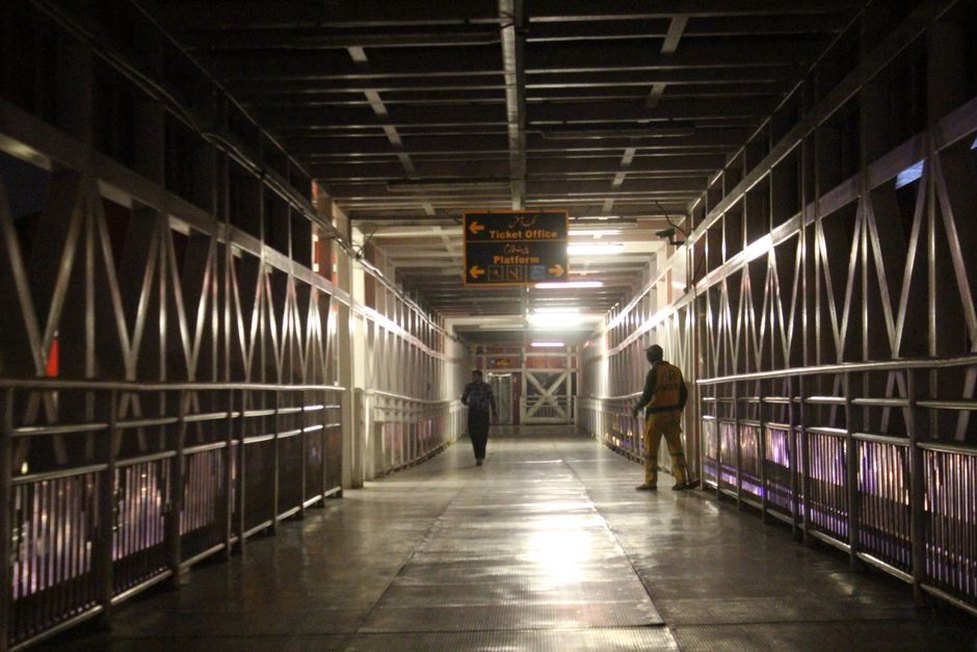
Picture two people approaching each other in a fixed-camera corridor. Foreground segmentation produces two regions before they overlap, one merged blob during the crossing, and two regions afterward. Looking only at the current frame gives a system no sound basis for assigning the outgoing blobs to the incoming tracks.
The clues span several frames. Predicted trajectories suggest where each person might emerge; their earlier appearances provide another clue; and track-management rules can keep both identities alive while separate measurements are unavailable. Sometimes the honest result is uncertainty. If the people look alike and reverse direction while hidden, the video may not contain enough information to settle the assignment.
Multiple-target tracking thus required more than running a single-target tracker several times. Data association—assigning new observations to existing tracks—became central. A nearest-neighbor rule was inexpensive but fragile in crowds. More elaborate methods compared competing assignments or kept several hypotheses across frames, delaying a decision until more evidence appeared. That helped at crossings, but the number of possible assignments grew quickly with each ambiguous detection.
- Initiation: decide when an unexplained observation is stable enough to become a new track.
- Association: connect an observation to a predicted track without treating proximity as proof of identity.
- Temporary loss: keep a track through a plausible gap while increasing its uncertainty.
- Termination: remove a track after sustained absence without mistaking every brief occlusion for an exit.
These choices changed the results people used. Initiate tracks too readily and noise becomes a crowd of false targets; terminate too quickly and one person reappears under several identities. In surveillance, traffic analysis, and laboratory video studies, counts and trajectories could be wrong even when individual frames looked convincing.
Getting a research method onto a real camera
Camera geometry and the background assumption
Background subtraction showed how far a clean formulation could be from a working camera system. A stationary camera could learn the usual scene and highlight new moving regions. Daylight changes, cast shadows, reflections, and repeatedly moving background objects could all look like foreground, however. An adaptive model might even absorb a person who stood still long enough, then produce misleading regions when that person moved. Researchers adjusted update rates, used color or texture cues, and checked spatial coherence rather than treating every changed pixel as a target.
Camera calibration made image trajectories more meaningful. Five pixels of vehicle movement between frames did not correspond to a fixed real-world speed; perspective, frame timing, and image position all mattered. If targets moved approximately on a known ground plane, a calibrated geometric mapping could support better speed or direction estimates. Calibration error and the ground-plane assumption still belonged in the interpretation.
A moving camera added another source of apparent motion. The scene might shift because of the camera, the object, or both. Estimating and compensating for dominant scene motion could help isolate independently moving objects if enough reliable background remained visible. Better feature matching, registration, and geometric reasoning could improve a tracker's measurements without changing its tracking algorithm.
Budgets, delays, and recovery
Early-2000s research systems had to weigh ambitious algorithms against real-time limits. Higher-resolution images supplied detail but made matching more expensive. Running a detector every frame could cost too much; trusting a cheap tracker indefinitely invited drift. A hybrid system might track between periodic detections, using the detector to correct or reinitialize the estimate. The schedule depended on the camera, processor, target size, and acceptable delay.
Frame rate changed the tracking problem, too. At a lower rate, objects moved farther between observations, so a narrow search window became less reliable. Dropped frames could resemble sudden acceleration. A tracker that performed well on uninterrupted prerecorded video might behave differently on a live camera with variable processing latency. Timestamps and end-to-end delay measurements helped distinguish target motion from scheduling artifacts.
What counted as evidence of improvement?
A striking demonstration showed that a tracker worked on one sequence, not that it could handle crowds, camera shake, or long occlusions. Researchers compared methods against annotated positions or identities, but evaluation was not yet as standardized as it later became. An average position error, overlap with a marked region, the number of lost tracks, and correct identity maintenance each measured something different.
A box could stay close to a pedestrian while the track took another pedestrian's identity. Conversely, the identity might remain correct while the box fit poorly during a pose change. Counting only frames in which a tracker stayed active could conceal difficult targets that were simply dropped. Useful reports stated when tracks started and ended, how missed observations were handled, and whether a person supplied the starting position or the system found it.
The test sequence mattered as much as the metric. A fixed-camera corridor favored different methods from a panning camera following a car. A short clip of isolated targets tested localization; a longer clip with entrances, exits, and repeated occlusions tested track management. Period demonstrations and conference reports are best read as accounts of particular experimental conditions, not proof that an algorithm solved tracking generally. For more on that research context, Reading 2000s Pattern Recognition Conference Proceedings examines how such work was presented and interpreted.
The distinct contribution of the period
Early tracking work was more than a prelude to later learned detectors. It developed inspectable ways to combine prediction, measurement, identity decisions, and failure handling. Its limits were part of the lesson: similar appearance did not establish identity, real-world motion estimates depended on camera geometry, and no filter could recover information the video never captured.
A crossing sequence annotated with two identities makes those limits plain. Mark where the separate observations merge, keep both predicted tracks alive through the overlap, and examine the first frame where the people separate. Two reappearing boxes are not enough. The question is whether each box retains the right identity—and, when the hidden interval leaves that unknowable, whether the tracker admits it.